|
return
to updates
The Allais
Effect
and Majorana
(modern
pendulum experiments)
by
Miles Mathis
January
25, 2008
In the
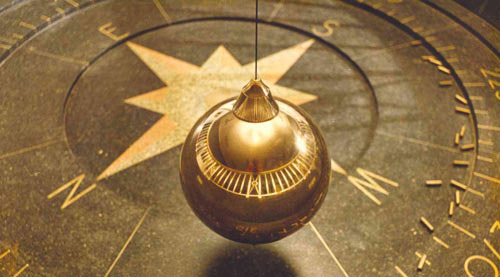
1950’s, Maurice Allais discovered a variation in pendulum
motion during his work with the anisotropic paraconical pendulum.
The most important variation was discovered during a solar
eclipse, but he also found a standard variation that recurred
about every 24 hours, 50 minutes. Allais used these variations to
propose that neither Newtonian nor Einsteinian gravitational
mechanics were complete. He presented a theory that centered on
the idea of a sort of ether, or what he called an anisotropy of
space. According to him, this required a reassessment of the
experiments of Michelson/Morley and Miller, and most importantly
of the theory underlying Relativity.
Three things
have conspired to keep Allais’ theories and findings out of the
mainstream. First is that he became more famous as an economist,
winning the Nobel Prize in Economics in 1988. Physics does not
currently take kindly to autodidacts, amateurs, or other
non-tenured “non-professionals” in physics. Second is that he
has made some rather politically incorrect comments about
Einstein, calling him a plagiarist. I have no intention of
entering a debate about the politics of priority here, so we will
move on. Third is that he contradicts the standard model, and
that is his real offense. The first and second faults here would
be overlooked if not for the third.
I discovered
Allais in a rather roundabout way. I was reading a book by
Webster Tarpley, and he mentioned Allais. I am not an economist
and not much interested in economics, so I had never heard of
him. Being universally curious, however, and in full control of
my computer, I did a quick search. In this way I learned not only
about his economic theories, which I find fairly useless, but
also about his physical theories, which I am still discovering.
My French is not really good enough to read at speed through
scientific papers, and only a part of Allais’ physical output
has been translated.
At any rate,
I saw fairly quickly that Allais’ effects fit into my theory
like a hand in a glove, with or without taking his theories along
with his effects. And that is why I have rushed this paper into
print, even before I fully understood Allais’ own ideas about
his effects. It may be that he and I agree on many things or not.
My opinions on Relativity
and Michelson/Morley
are well known to those who want to know them, so I will have to
let others compare my opinions to those of Allais. For now it is
more important that I tie Allais’ pendulum to my theory of
gravity and E/M, and specifically my correction to tides.
I have shown
in a series of papers that what has been called the gravitational
field is in fact a compound field, one that includes both the
field of gravity and the foundational E/M field. I have even
presented equations
that show how to separate the two fields out of Newton’s
equation. In this way I claim that I have found the unknown field
of Allais, and the cause of his effect.
This brings
me to Majorana. In researching Allais, I also stumbled on another
experiment that is now mostly hidden, that of Quirino Majorana.
His nephew Ettore is somewhat better known, both for being called
a genius by Enrico Fermi and for his mysterious disappearance.
Quirino is now mentioned only in regard to “gravity shielding”.
He has no page of his own at Wikipedia, and the page on gravity
shielding is a whitewash. Nor is it only Wiki that has been
cleansed. Majorana’s original papers from 19201 are
no longer available at Philosophical Magazine, although
the journal does exist. You can’t even order them online, since
the back issues stop at 1925. Other papers relating to gravity
shielding have also been removed, for example a paper that was
until recently at adsabs.Harvard.edu called “An Experiment
Concerning Gravitational Shielding” by L.B. Slichter, M. Caputo
and C.L. Hagar, 1965, Journal of Geophysical Research.
History is being cleansed to protect the status quo.
The only
thing I could come up with on the internet at short notice is the
response to Majorana by H.N. Russell from 1921.2 The
Wiki page on gravity shielding neglects to mention that Majorana
came to his theory, like Allais, via pendulum experiments, but
Russell is nice enough to tell us this himself. He also tells us,
“Professor Majorana, in a very interesting series of papers,
has proposed a new theory of gravitation, with experimental
evidence supporting it.” Notice that last bit. Although Russell
contradicts all of Majorana’s conclusions, he is gracious
enough to admit that some evidence was presented. Wiki wants us
to think Majorana just pulled his ideas out of the air, proposing
a new extinction coefficient simply to be contrary. By extinction
coefficient, they mean h in this equation:
F = [GMm/r2
][e-h∫ρ
rdr]
But Majorana and Russell wrote it
like this
F = [GMm/r2
][e-∫
hθ
dr]
Where h is “a second universal
constant, that of absorption of gravitation” [quote from
Russell] and θ is the density of matter along the line of
attraction.
Because the best laboratory
experiments have produced “an upper limit for shielding of
4.3×10⁻¹⁵ m²/kg” [Wiki], we are told that Majorana
cannot be correct. Russell puts it this way: he says that any new
field must create a force, and that current equations and data
have no room for such a force. Take the Moon as an example, he
says. If e takes on any measurable value in the equation above, F
must change and with it any and all orbital numbers.
Russell is quite right about this,
so rather than defend Majorana, I will defend my own equations. I
will push both Majorana’s findings and Allais’ into line with
mine, showing that neither Russell’s nor any of the standard
model’s historical complaints touch my theory. None of the
critiques against Majorana or Allais concern me, since my
equations and theory are not theirs.
Before I show this, I will make a
short diversion into LeSage. I have to admit that I just
discovered LeSage during this research into Allais and Majorana.
I have been making my own way since the beginning, and have not
always been aware of those who had made similar paths in the bush
before me. Lesage (c1750), following Duillier (c1690), is famous
for proposing what is called push gravity. This is an explanation
of gravity by which all objects are radiating a field.
Attractions are then caused by shielding this field. I have been
mistaken as a proponent of this field, and I now see why
(especially considering my new paper on Cavendish, whereby the
attraction is caused by shielding). But my theory is not push
gravity.
Majorana has been tied to LeSage,
since he also proposes shielding. But, as you can see from
Russell’s description above, Majorana is proposing a second
field, and only the second field is a shielding field. This is
closer to my theory, since we have two fields here, but
Majorana’s theory and equation are not equivalent to mine
either. Majorana does not tie his second field to E/M, or explain
how it fits into Newton’s equation. As you can see, he wants to
add an effect to Newton’s equation, which must push it
out of line. But I take Newton’s equation to be correct, then
insert my E/M field directly into it. This means that with
my equations, no variance from current numbers will be found,
unless the E/M field is blocked. This is how my equations answer
both Russell’s paper and all more recent critiques of push
gravity, shielding, and Allais effects. I don’t propose any
variance from current numbers, since I show that (minus
Relativity) Newton’s equation is correct. Rather, I show that
Newton’s equation already describes a compound effect,
and that the numbers we have now are compound numbers, achieved
by a differential field. We could not find variance unless we
blocked one or other of the two constituent fields.
However, I have also denied that
gravity can be blocked. I have defined gravity as acceleration
only, and acceleration cannot be blocked. In this way I concur
with standard model assumptions and the equivalence principle of
Einstein. The gravitational component of the compound field
cannot be blocked or shielded in any fashion. Only the E/M
component of the field can be blocked, and this is what is
happening in Cavendish. Once
the E/M field is blocked, you get a variance in the total field.
But this would not affect orbital numbers or any other
astronomical numbers. All our experimental values would be
expected to stand with my equation, except values achieved
during eclipses. During eclipses, we would have shielding by
solar system bodies; and only during events like this would our
equations behave like I have shown the Cavendish equations
behave. In normal situations, my equations are not at all like
those of LeSage or Majorana, neither numerically nor
theoretically.
This is all to say that neither
LeSage nor Majorana nor Allais proposed the correct differential
field. The correct differential field would show no variance from
Newton’s equation under normal circumstances, confirming
current data, but show the reason for variance during an eclipse,
confirming their own data. Allais gives us no specific equations,
that I have found. Majorana’s equation fails as I showed above,
since it would show variance in all situations. In his equation,
the variable F changes with any and all field densities for θ.
Variations in his second field must cause a variation in F, and
these variations in his second field would always be present. All
real fields have real densities, so that all real equations would
have to deviate from Newton. In my equation, this is not so. My
equation is
F = E + H
Where E is the foundational E/M
field and H is the gravitational field caused only by
acceleration. F is then the compound field found by Newton’s
equation. So neither of my fields is an addition to Newton.
Newton’s equation already included them, so no variance
will be found, short of an eclipse.
This is just to say that Majorana’s
field density is external to the classical and currently accepted
value for F. This is because the variable θ is not part
of the term GMm/R2. His field density is external to
that term, and therefore outside of F. But my field density is a
part of F. In my theory and equations, the field density is
important only regarding E, but E is part of F, as you can see by
the equation F = E + H. If the field density is part of E, it is
also part of F. My density is not external to F.
Many of the so-called “crank”
solutions posted on the web to the Allais Effect and other
anomalies have the same problem Majorana had with his equation. I
do not think most of these solutions come from cranks, but they
are mistaken. The standard model is also mistaken, so calling
people that are wrong “cranks” is hardly to the point. It
would be better to show where they are wrong. Let’s look at
one: the highest listed on a current web search (Jan. 2008). This
belongs to Joseph
Nduriri, who has been very active recently, posing his
solution in many forums. Mr. Nduriri’s solution is no worse
than Majorana’s, and Majorana was no crank. But they fail for
the same reason. Mr. Nduriri’s central equation is this one:
F= (-Gm1m2 +
kq1q2)ur/r2 + (
μgm1m2 + μoq1q2
)V1×(V2×ur)/r2
Not a bad looking equation, except
that you can immediately see that this will give a straight
addition to Newton’s equation. Mr. Nduriri’s F, like
Majorana’s F, will not match Newton’s in normal
circumstances. And Mr. Nduriri’s addition is not a relative
one. He is trying to add the E/M field to the equation, in the
same way I did. The problem is that his equation gives us
variation even when we don’t want or need variation. It
predicts variance in situations that we know, experimentally,
have no variance. What Mr. Nduriri wants is an equation that
includes his E/M field within
the old F, that is to say, within GMm/r2.
But the form of his equation makes this impossible. He has
Newton’s equation, and then some. But Newton’s equation is
already correct. It doesn’t fail. It only fails to include the
E/M field. So Mr. Nduriri’s equation can’t be the correct
one.
LeSage proposed that gravity was a
push. I show that our field of data is both a real push and an
apparent pull. Two fields. Majorana proposed two fields like me,
and in opposition like me, but he added the opposition outside of
F, as another term in the equation. I have shown that it must be
included within F, as a part of the classical measured force. To
say it another way, Newton's equation was already unified,
unknown to him. It already contained and contains E, buried in
the constant G. So Newton didn't need to be unified with E, it
needed to be pulled apart, or un-unified. Only I have done that.
But notice that my inclusion of the
second field within F does not change the mass of either object.
You will think that it must change either the mass or the radius,
since those are the only variables we have in the term GMm/R2,
but I have shown that it doesn’t work that way. Russell
proposed, like me, that the variation must be within Newton’s
equation itself, within F, and he was correct in that. But he
thought the only other place the variation could take place is
within the masses.3 This is not true. Look at my
segregated equation again:
F = E + H
H = m(A + a)
E = [GMm/R2 ] – [m(A +
a)]
Where H is the gravitational part
of the equation and E is the foundational E/M field or the charge
field. Obviously, F is not going to change from the values of
Newton’s equation, unless you block E. If you block E, then the
F will become H. But the masses in F and H and E are the same. I
don’t propose any change in mass, whether E is blocked or not.
The m in H and in E is exactly the same. Variance is not caused
by a change in mass or by an absorption of gravity. It is caused
by blocking the E/M field, and this causes the full expression of
H. Which means that gravity is never absorbed. In normal
circumstances, gravity (H) is partially offset by E. Offset,
not absorbed. But during an eclipse, H would express itself
without the presence of E, becoming greater.
This also answers the primary
criticism of Lesagian gravity, made by many including Feynman,
which is that absorption of any kind of ether or field of real
particles would create massive friction, leading to the Earth
(for example) becoming white hot in short order. But my theory
quickly walks around that weak criticism, since my charge field
of real photons is not just absorbed, it is channeled
through all objects, including the atomic nucleus. Regarding the
Earth, this field is channeled to the poles in huge vortices,
moving through the interior before being re-emitted, most heavily
at the equator (or 30N and S). And it does indeed create heat on
this journey: that is where the heat of the core comes from, not
from spinning iron or other dynamos.
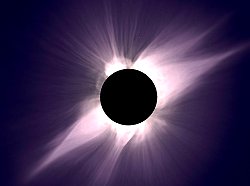
Now let me show you how this solves
the Allais Effect. In a Solar Eclipse, we don’t have a straight
blockage of an E/M field, so the effect is not the simple one I
have just glossed. Yes, in a Solar Eclipse, the Sun’s E/M field
would be blocked. But I have shown in other papers that the Sun’s
foundational E/M field is negligible at the distance of the
Earth, so this won’t help us explain anything. And in a Solar
Eclipse, we still have the E/M field of the Earth and Moon,
unaffected by any blocking or shielding. So we cannot find the
Allais Effect by a simple differential. What is blocked in a
Solar Eclipse is the Solar Wind, and the importance of this is
shown in the third
part of my tidal series.
Up to now, given standard model
equations, blocking the Solar Wind would not have explained
anything. As long as tidal and pendulum effects were explained
only as gravitational, the loss of the Solar Wind could not have
been of any import. But now that I have shown that Newton’s
equation always includes the foundational E/M field, the Solar
Wind must play an important role in many motions that were always
thought to be gravitational.
Concerning tides, I showed that the
main cause of influence was the foundational E/M field, not
gravity. That is to say, the same field that mediates the force
between the proton and electron mediates the tides on the Earth,
and is a player in all forces at all levels in the universe. Up
to now, QED has ignored the mechanics of quanta interaction,
studying only probabilities. The mediator of the field has not
yet been discovered, and has not really been sought or even
hypothesized. What we have now is only the skeleton of a theory
about a messenger photon, one that can cause both attraction and
repulsion. I have shown that this theory is non-mechanical and
theoretically useless, and I have replaced it with one
that is more consistent and useful. I don’t need to restate
that theory here; it is enough to show that any such field (even
the one we have now consisting of messengers photons), once shown
to exist, must exist not only at the quantum level, but at all
levels. Any field that is more than an intellectual abstraction
must exist in space. If it exists, it cannot stop existing once
you leave the quantum field. Modern physicists have assumed,
without doing any math, that this quantum field must be too small
to affect macro-objects, but this assumption is false. Actually,
no one that I know of has even thought to ask about the
macro-presence of this field, since the field has never yet moved
beyond being a mathematical postulate. If physicists have not
found it necessary to give this field a meaningful mechanical
expression at the quantum level (and they haven’t), why would
they think to apply it to the macro-world? Due to specialization,
most quantum physicists have forgotten that the macro-world even
exists. Many of them state out loud that it doesn’t, really: we
wouldn’t even have
a macro-world if it weren’t for decoherence, according to
them.11
At any rate, it is this field that
I am calling the foundational E/M field, to differentiate it from
the E/M field mediated by electrons. The foundational E/M field
controls the more obvious field of electricity and magnetism, but
the two fields aren’t the same thing. One is mediated by
electrons, the other by some kind of photon (we assume). But it
is this latter field that causes tides. And it is this field that
I will show must affect a pendulum.
In my tidal papers, I have actually
shown a number for this field on Earth. At the surface of the
Earth, the field causes an acceleration of -.009545m/s2,
in vector opposition to the acceleration of gravity. If this
field is blocked, then the compound field increases, bumping the
number for gravity, 9.8, up to 9.81. So if you block the
foundational E/M field, your weight would increase,
throwing a wrench into the anti-gravity efforts of NASA (see
below).
But, as I already said, an eclipse
will not block this field. This field arises mainly out of the
Earth. The Moon’s field affects it, but the Sun’s field does
not affect it appreciably. So even during an eclipse, the field
is present. Neither the gravitational field nor the foundational
E/M field is being blocked during an eclipse, which is what makes
my theory and equations so interesting. I am not proposing some
simple-minded effect, I am proposing a complex mechanical
explanation, complete with equations and numbers. And, as it
turns out, my explanation confirms the most orthodox explanation
of the Allais Effect, according to NASA’s own website. NASA
lists possible causes of the anomaly, and “solar radiation”
is one of them—the least controversial of all. It is nice to be
slightly non-controversial for once.
I have shown that with tides, the
Solar Wind is the main cause of spring and neap variations. In
the third part of my tidal series I
even provided the numbers. I showed the acceleration from the
Moon to be 4.7 x 10⁻¹⁰ m/s2,
and the acceleration of the Solar Wind to be 1.87 x 10⁻¹⁰
m/s2,
providing a 40% variance between spring and neap positions. You
will say that is a very small acceleration, but it is applied to
a kilogram, so it is not a negligible force. In fact, I
just showed in my last paper before this one that it is about
the force acting in modern Cavendish devices: enough to move lead
balls in a very short time. In considering pendulum variations,
we will look at the same factors, but change the positions of the
players.
Basically, the Solar Wind draws off
energy from the Earth-Moon E/M system. Both bodies must use
energy blocking the Solar Wind, and this energy comes from the
E/M field. But the Earth’s use of its E/M field to block the
Solar Wind varies depending on the position of the Moon. This is
simply because the Moon is an important player in the combined
field. In fact, I have shown the numbers that prove that the Moon
is a very large player in this drama, having a vastly greater
foundational E/M field than would be expected according to the
standard model. This is obvious, regardless, since the standard
model doesn’t even know about the existence of the field I am
talking about; but even if they did admit its existence, they
would never expect the Moon to have a field as active as it has.
In a nutshell, this is because the foundational E/M field is
emitted by quanta, and it increases in strength with smaller
spherical macro-objects. That is to say, the emitted field
becomes denser very fast, with decreasing size and equivalent
object density, due simply to the nature of a spherical field. I
have shown that the Moon has a stronger foundational E/M field
than the Earth (as a matter of density), not just relatively, but
absolutely.
At any rate, I have shown that it
is this field that causes tides. It is this field that allows for
a force at a distance, since this field is a real bombarding
field. The Moon does have a gravitational field, but this field
is an acceleration field, and cannot affect the Earth at a
distance (except as it directly and mechanically affects the
material E/M fields between the Earth and Moon). Given that fact,
it is clear how the Solar Wind interrupts this field. As I said,
it draws off energy from this field. The field is required to
expend potential fending off the Solar Wind, and it expends this
potential whether parts of the Wind are positive or negative. I
show this in more detail in my tidal papers.
However, during an eclipse, the
Solar Wind is blocked partially or completely over extended areas
of the Earth. This must give rise to a temporary increase in the
total potential and total E/M field in those areas. The E/M field
isn’t being sapped as much by the Solar Wind, so it increases.
If we plug that effect into my differential equation F = E + H,
we must find a temporary decrease in F, or in what we now call
gravity. Since E is always negative to H, it might be clearer to
write the equation F = H - E. H never changes, since it is an
acceleration and depends only on the size of the Earth; nor can
it be blocked. So if E gets larger, F gets smaller.
You can see that this immediately
gives us not one, but two visible effects during eclipse. We have
a more active E/M field, which will cause motions due to that
variance; and we have a separate but related decrease in weight
of all objects in the vicinity.
You will say, "Didn't you tell
us above there is no mass change?" That is correct. There is
no mass change. The weight change I just mentioned isn't a mass
change, it is a force change. The unified field force changes
because the charge field has changed. But that is not a mass
change.
My theory also explains why
gravimeters are less likely to find a variation during eclipse
than a pendulum. Old-style gravimeters would have been more
likely to find the same effects as a pendulum, since the
mechanism of these gravimeters was a spring. A spring, like a
pendulum, is a macro-object. It is a rather large object, one
that you can hold in your hand. This is important because these
large objects create surfaces that interact with the E/M field.
But newer gravimeters are fancier things. They work with laser
interferometers, measuring fringes, and lasers cut right through
a photon field. More importantly, these new machines are very
small. A modern drop machine has a tiny object falling only 20cm,
and a rise and fall machine may have an even smaller object
moving through only 4cm. This makes the time of measurement on
the order of 200ms. The interaction with the field has been
minimized, you see, and so it should not surprise anyone that
variations are difficult to measure with a modern gravimeter.
Current scientists are assuming they are measuring an
acceleration field only, with no emitted particles. Strictly,
they are measuring a motion, not a field. But since the
E/M field is involved, as I have proven, the gravimeter should be
made to test larger objects over greater times, not the reverse.
A useful device, measuring a compound field, must allow for a
substantial interaction with the emitted field. Otherwise it will
under-report this field. If you under-report this field, you have
failed to find the existing variation. This is what is happening
with small, fast gravimeters.
Now let us return to Allais’
pendulum. I have shown that F should decrease under an eclipse,
according to the mechanics of my fields. If we decrease F, we
decrease g.
T = 2π (√ L/g)
That is the equation for the period
of the pendulum. If we decrease g, we must increase T. Allais’
pendulum should swing wider. Allais reported no such increase,
since he was not measuring the period.
But Saxl & Allen reported
precisely that in their famous torsion pendulum experiment of
March 7, 1970, published in PRD. This experiment was done in
Boston, just north of the eclipse line (96.5% total), and nowhere
near either end of the line. I have been able to find nothing
wrong with their experiment, according to my fields and theory.
Luo Jun and his team published
results in PRD in 1991 of their measurements with a torsion
pendulum. They traveled to Bjelomorsk in Russia in 1990, and
claimed to have refuted the results of Saxl & Allen. The
problem with their experiment, according to my explanation of the
fields, is that they were in the wrong place. It would have been
a much shorter trip for them (from China) to have gone straight
north to a town like Aliskerovo, Siberia, which was at greatest
eclipse, directly in the line. Instead they traveled thousands of
miles west, almost to Finland, and there the eclipse line was at
an end (it was the beginning of the line, actually). You can see
this by going to the Google eclipse map of July 22, 1990.
The reason this is a problem is
that the blocking is going to be greatly decreased at either end
of an eclipse line, since the effect of the Solar Wind is going
to be “leaking” back in (from the West, in this case). You
can be above or below an eclipse line and still expect an effect:
meaningful percentages of the Solar Wind will be blocked in those
positions. But you cannot be beyond either end of the line, for
obvious reasons. The normal Solar Wind exists in those positions.
Jun was quite near the line, which normally would be good, but he
was too close to the end of it. From the published map, I
cannot tell how near the end he was, but he was very close. It is
not at all clear to me why he would pick this position over a
greatest eclipse position that was nearer to him. Even without
knowing of any Solar Wind effects—even accepting the standard
model in toto—there is no reason for him to have gone to
Bjelomorsk. One suspects, after the fact, that he may have done
so specifically in order to refute Saxl & Allen and to
bolster the standard model.
Beyond this, Jun begins his paper
by stating that Saxl & Allen found a period of relative
increase of 2.7 x 10⁻⁴. But Jun’s abstract tells us
he found any relative change must be less than 5.2 x 10⁻⁵.
According to my calculator, that difference is only a factor of
5. So he found at least five times less effect than Saxl &
Allen. Not a very strong refutation, given that he traveled 6,000
miles to find a location with a weaker effect. It is not so
surprising that he found it.
Another Chinese paper published in
PRD is that of Wang et. al. from 2000. This is a gravimeter test
at eclipse with a decrease in weight. The experiment has been
repeated by them many times in many places, the last in 2002, all
showing a gravity decrease. This team has been attacked by the
standard model police due to these results, finally forcing them
to stage PR responses in 2003 and 2004.
The key element of this experiment,
in my opinion, is their use of the LaCoste-Romberg D gravimeter,
a well-known, widely used, and respected instrument. To date, no
one has been able to spot a flaw in the instrument or the
procedure. But I spotted the key fact immediately. If you go to
the LaCoste-Romberg website, almost the first thing you discover
is that the gravimeter is all metal. We are told, “Few ferrous
metal parts are used in the meter. The meter is demagnetized or
compensated, then installed in a double μ-metal
shielding to isolate it from magnetic fields.” But this means,
1) some ferrous metal parts are used, 2) metal parts that are
demagnetized or shielded from magnetic fields are not thereby
shielded from the foundational E/M field. Again, the foundational
E/M field is the charge field, and it is made of photons, not
electrons.
I am not saying that this means the
machine is flawed. It means it is a good measurer of F precisely
because it is a good measurer of both H and E. Due its makeup, it
fails to respond to magnetic fields; but due to this same makeup,
it responds particularly well to E. Remember that E in my
equation is neither the electric field nor the magnetic field. It
is the sub-field that creates them both [I
have since shown this field is equivalent to Maxwell's D-field].
The electric and magnetic fields are caused my the motion of
electrons. E is caused by the motion of photons. Lacoste and
Romberg shield their gravimeter from electrons, but not from
photons, which is perfect here. We get a machine that is a lovely
conductor of photons and a lousy conductor of electrons, just
what we want to measure small fluctuations in the foundational
E/M field.
The second reason the
Lacoste-Romberg would be expected to work well in finding eclipse
variations is that it is neither a drop machine nor a
rise-and-fall machine. It is a spring and hinge machine. It is
small, but it isn’t measuring an event like a fall, that takes
place over 4cm or 200ms, so the interaction with the field is not
limited.
In Current Science [June 10,
1997] we have another gravity decrease found with a metal Lacoste
and Romberg, by the team of Mishra and Rao, in India. This one
was slightly easier to ignore than the one of Wang (because US
scientists find it easier to ignore India than China), but now
that it has been confirmed multiple times by Wang and made the
pages of PRD in that way, it should no longer be ignored.
As for the article in Nature,
1955, by Tomaschek, I think he himself admits his machines were
useless under the conditions. I have said that old style
gravimeters might give better results in response to the
variation in the E/M field during an eclipse, but this is
assuming they are in optimal conditions, unaffected by other more
mundane interruptions. Tomaschek used three meters, a Frost 32, a
Frost 54, and a Worden. He tells us that the Worden and the Frost
32 responded poorly to temperature and pressure extremes in the
Shetlands, and that the Worden showed an “elastic drift”. His
best machine, the Frost 54, had an accuracy of ±
3 percent. I think we can therefore leave these gravimeters out
of it.
Then we have Kuusela’s torsion
pendulum experiment of 1991, published in PRD, which found no
eclipse effect. The problem here is that the eclipse was on the
horizon. If you draw a simple schematic of the required positions
of Sun, Moon, and Earth, to create this eclipse for the viewer,
you quickly see that very little of the Solar Wind would actually
be blocked from the Earth in this case. Like the light, it would
be blocked for the viewer. But the largest part of the Earth
facing the Sun would get no blocking at all. Only a tiny “heel”
of the Earth is experiencing the block at any moment; the rest of
the blocked area is out in the atmosphere, above the viewer,
where the E/M field strength of the Earth drops off. This is why
little or no pendulum effect would be expected.
If that seemed a bit vague, let me
put it another way. Kuusela had the same problem as Jun, above.
If you are above or below the line, you can expect a sizeable
effect, given my fields. But if you are very near either end of
the line, you are going to get leakage. You are very near the
normal field—where the eclipse is zero—and there are no field
walls. If the Solar Wind is creating normal effects just a few
miles from where you are, then that is going to affect your
measurements, too. Which is just to say that anomalies caused by
an eclipse must drop off near either end of the line.
But the same is true here with
eclipses right on the horizon. When the eclipse is right on the
horizon, it is like always being at the end of the line, wherever
you are. This is proved by looking at the eclipse map for
Kuusela’s experiment. He measured the same eclipse as Luo Jun’s
Chinese team: July 22, 1990. Remember that I said Jun went almost
to Finland, and was very near the end of the line? Well, Kuusela
is Finnish, and he was in Finland. Specifically, he was in Turku,
25 km from the zone of totality. Problem is, he was 25km past
the end of the line of totality. Due to the movement of the Sun,
he was actually 25km past the beginning of the line, but
the idea is the same. He tells he was at 99.8%, which sounds
great until you remember that his .2% was right out in the
breeze, so to speak.
What I mean by that is that if you
are somewhere along the middle of the line on the great eclipse
map, and you say you were at 99.8%, that means that an area in
front of you is at 100% and an area behind you is at 99.6%. Areas
to the side of you are also at 99.8%. But if you are slightly off
the end of the line, like Kuusela is, then when you say you are
at 99.8%, that means that an area in front of you is at 100%, but
areas pretty close behind you and to both sides are at 0%. This
must make a big difference according to my fields. This is what I
mean by “leakage.” Your results are literally going to be
leaking away to the fields nearby. Real physicists should know
this, and it is probable they do know it. Like Jun, Kuusela
probably measured where he did knowing his data would be null.
Now let's look at Ieronim Mihaila’s
experiments, briefly. These were done in 1999, 2003, and 2005, in
Bucharest, Romania. Mihaila used both Foucault pendulums and
Allais pendulums. With both he found a slowing of the period,
confirming Allais. They also showed a movement of the plane of
motion toward the eclipse line. Both findings confirm my theory.
On August 11, 1999, Mihaila was very near the point of greatest
eclipse, which was between Belgrade and Bucharest. On May 31,
2003, Mihaila was above the eclipse line but nowhere near the end
of it. His experiments are a standard confirmation in all ways,
and only merit an extended mention here as politics. His papers
were published in the Romanian Academy, but refused by the French
Academy. Although Maurice Allais himself scolded the French
Academicians for this, the standard model—arising from Harvard
and MIT and such places in the US—has used this refusal as
basis for dismissing Mihaila in toto, as little more than
a crank. This despite the fact that he is a professor at the
University of Bucharest, where he has taught both astronomy and
mathematics, as a member of both departments. Other papers by him
can be found at Springerlink and adsabs.Harvard.edu. In this
regard, he is clearly a victim of worldwide blacklisting for his
threat to the standard model.
Before I move on to the discussion
of the sideways motion of the pendulum, I want to touch on one
further experiment which appears to confirm the weight change, or
the effect on g. This is the experiment of G.T. Jeverdan, also of
Romania. He was in Jassy in Feb. 15, 1961, just north of the line
(which went through Bucharest), and fairly near the greatest
eclipse, which was in the eastern Ukraine. He was nowhere near
either end of the line. He used a very long Foucault pendulum.
The problem for me is that he found a decrease in the period and
an increase in g, the opposite of what I predict.
Jeverdan’s
report is very brief, and it doesn’t divulge enough details
to make a full analysis. Its brevity makes it difficult to find
what may be the cause of the variance. However, rather than
dismiss Jeverdan out of hand simply because I don’t like his
findings (as the standard model does now, over a broad swath of
topics), I prefer to assume that he was correct and see if I can
incorporate his data into my theory with the rest. It looks very
difficult to do at first, which has kept anyone else from
attempting it. But I will press on regardless.
In analyzing the pendulum equation
T = 2π (√ L/g), I have noticed that we have not one but two
possible variances, due to my new theory. Which is to say, an E/M
theory like I propose will actually enter that equation in two
separate places, since a force change will enter it in two
different places. I have shown above that it enters through the
variable g, which causes a variation in T. But the tension on the
wire or other hanging apparatus will also vary. This second
effect will be in opposition to the first.
If we block the Solar Wind, we
increase E, which decreases g and increases T. This is the effect
I have shown above. But if we decrease g, then we also decrease
F, and this must effect the tension of the wire and the weight on
the wire. If we decrease the tension and weight of the wire, we
decrease T (simply because we make the swinging motion easier: if
it is easier, it is faster). Now, above, with the other pendulum
experiments, I simply assumed that the effect on g would trump
the effect on the tension, giving us an increase in T. But this
may not be so with all pendulums. Let’s look at the difference
between Jeverdan’s pendulum and the other pendulums.
As I said, Jeverdan had a very long
Foucault pendulum, with a wire 25 meters long and a weight of the
bob of 5.5kg. We don’t know the diameter of his wire. If we
look for equations to apply to the tension, we have problems. The
equation above has no mass or tension variable, as you see. And,
as one expert recently said, “The manner in which the wire
tension varies with the motion [of the Foucault Pendulum] is
unknown, and its elimination from these equations only serves to
further complicate matters. It is possible, however, to derive an
approximate solution for small amplitude oscillations.”3
He then gives us some extensions of Hooke’s law, which would
dirty rather than clarify this paper.
It is better to keep it simple
here, and state that tension is a measure of force per unit
length. As usual, the standard model gives the important
dimensions to the constant, and it is actually the constant in
Hooke’s equation that has these dimensions; but here it is
better to think of these dimensions applying to the tension. This
is because it allows us to see very quickly that a longer wire,
in eclipse, is going to lose more tension and weight than a
shorter wire. Every unit length of the wire loses weight and
tension. You will say that all pendulums with bobs of equal mass
will lose the same amount of weight from the bob, and this is
true; but they don’t lose the same weight from their wires,
since their wires don’t weigh the same. This must affect the
tension. Even if their wires weigh the same per unit length, a
longer wire must have more total weight, and therefore more
variation in eclipse. This will be especially true of long thin
wires, since we have less mass per unit length. A shorter or
thicker wire will resist changes in force more easily, since it
has more mass per unit length. Molecular forces will resist the
full expression of variation: some changes will be absorbed, or
will not overcome molecular forces. But in a long thin wire, with
little mass per unit length, the force will be more fully
expressed.
So, you will have a greater force
per unit length, due to the greater mass of the wire itself, and
a fuller expression of this force, due to the lower mass per
length. But there will also be a third factor, and that is the
change in the gravitational field itself. The two ends of a wire
25 meters in length aren’t even in the same gravitational
field, precisely. The bob, at the bottom, is feeling more
acceleration than the ceiling, from which the wire is hung. This
compounds the effect, since we have a small inverse square effect
here. If we measured the tension from the top, we wouldn’t get
the same number as the tension from the bottom. To get the right
answer for what the wire is feeling itself, we have to sum as we
move along the wire, rather than sum from one end or the other.
But as we go up the wire, the bob will seem to weigh more and
more (very very slightly, of course). And this effect is in
addition to the weight of the length of wire below us. Even if
the wire weighed nothing, we would still measure a heavier bob as
we go up, due only to the change in acceleration from the field.
If the bob seems to weigh more from
the top, then any change in weight will also be greater,
summed over the length of the wire.
You will say, according to my new
theory, gravity is only an acceleration, not a force. I have said
elsewhere it doesn’t even obey the inverse square law. I have
said that Newton’s equation obeys the inverse square law only
because it contains E, and E obeys the inverse square law. And
yet here I am finding an inverse square difference. How is that
consistent?
It is consistent since we have the
compound field in effect here, in this problem, not just my field
H. Yes, my field H does not obey the inverse square law (except
in transforms). But the pendulum here is not swinging through H
only. It is swinging through F, as I said above. F works in the
classical way, since it contains both H and E. F obeys the
inverse square law. Therefore the pendulum will be obeying the
inverse square law. A very long pendulum will find a variance due
to this inverse square law, even minus any relativity transform.
Now, I admit that all three of
these effects I have just listed are very small. I don’t have
equations to balance any one of them or all of them with the
variation I have proposed for g. I can’t prove at this time,
mathematically, that tension becomes the greater effect in the
pendulum equation with Jeverdan, explaining his reverse effect. I
can only suggest that this may be the case. It is certainly
interesting to note that all the other pendulums, including those
of Saxl & Allen, Mihaila, Allais, and the rest, are much
smaller than that of Jeverdan. Allais pendulums and torsion
pendulums are normally much shorter than Foucault pendulums, and
Mihaila’s Foucault pendulum, although large [14 meters], is
only a little over half the size of Jeverdan’s. And, though it
was shorter, it had a greater mass at the end [7.3kg].
It is my opinion that the most
intelligent, as well as the most gracious thing to do, is to
assume that Jeverdan’s data is correct like all the rest. Then
we try to show how his reverse effects may be logically and
mathematically explained, with no contradictions. In this line, I
assume that the mechanisms I have enumerated here are all at
work, and I will try to develop equations to show precisely why
and where the effect of tension overcomes the effect of g in the
pendulum equation. It seems to me that since we don’t have a
full understanding of the pendulum, we should welcome this data
with open arms. It is precisely data like this that will allow us
to develop a full equation that includes tension, mass, g,
inertia, and so on, all in the same equation. Therefore, we
should start with the assumption that we have useful data here,
data that may be telling us something. Only once we have
exhausted all possibilities in that line should we begin stating
authoritatively that either Jeverdan or Mihaila must be wrong.
One of them may be wrong. But we should also consider that they
may both be right.
Now let us move on to the other
pendulum motion seen, the change in the plane of swing that is
the main outcome of Allais’
data. The first thing to notice here is that Allais was south
of the line, and the plane of his pendulum moved north. He tells
us it moved 15 centesimal degrees; and while I only count about
11 from beginning to top, the more important feature, in my
opinion, is that it moved northward, from approximately 173 to
184. Allais tells us he was “measuring azimuths from the south,
in a direct sense.” Therefore, we may deduce that his pendulum
moved toward the eclipse line.
In all the other experiments that
measured this motion, we see the same thing. If the experimenter
is south of the line, he sees a deflection of the azimuth north.
If he is north of the line, he see a deflection of the azimuth
south. For example, in all three experiments, Mihaila was north
of the line, and all three times he found a deflection of his
plane of oscillation toward the south. The only experiment I
haven’t mentioned yet, of Oct. 3, 2005, Mihaila was well above
the line (the annular being in Africa). He was nowhere near
either end of the line. He found a deviation of about one degree,
to the south.
Another experiment also confirms
this, without the use of a pendulum. Latham and Last performed
gyroscopic experiments during the eclipse of June 20, 1974, in
Perth. They were north and east of the line and near the center.
The gyroscope was unaffected, but a Talyvel electronic level
placed on the base of the gyroscope measured a five arcsec
change. Since the level was mounted E/W, and the change was
negative 5, we may take it that the change of direction of g they
thought they were measuring was toward the eclipse line.
It is interesting to discover that
Latham
proposes an aether traveling at 500km/s to explain his
findings, since this is now the speed given to the Solar Wind by
the standard model, based on direct measurements by satellites.
It is not clear where Latham pulled this number from, but it is a
lovely estimate, especially if he based it only upon the effect
seen. Against this is that he says, directly afterwards, that it
is not clear why the effect is so small, considering that an
“aether flow of 500km/s would cause enormous mechanical
changes.”
Yes, it would if it were not
blocked, but we know it is
blocked, in large part. The standard model proposes it is blocked
by the magnetosphere, but they haven’t proposed what creates
the magnetosphere. I
have proposed that my E/M field creates it directly, with
emission from quanta, without the need of iron dynamos in the
core of the Earth. In either case, it explains the tamping down
of the Solar Wind, or of Latham’s aether, in normal
circumstances. But because Latham did not include the
foundational E/M field in his theory, he did not come to the
correct equations or conclusions. However, I must say that there
is much in his theory to be commended, and that it is close
enough to the truth to have diverted me if I had come upon it
sooner. I am fortunate, I think, that I did not.
Although there are points to like
in Latham, there are other points against him. One is his
explanation of why the gyroscope showed no deflection, while the
level did. The correct answer is that his level has a little
pendulum inside it.5 But the gyroscope is not set up
to respond to either of our postulated variations here. It is not
a gravimeter, so it will not register a change in mass or g. And,
since it is fixed both top and bottom, it cannot swing. It is
spinning, so the only thing it can measure is a change in tilt.
We have no change in tilt here. Latham proposes that the
direction of g is changing, but that is not what is happening.
Nothing is happening to the centripetal acceleration of the
Earth. That is clear no matter what theory you are following.
Only that would cause a change in tilt. What is drawing off the
pendulums and the level is not the gravitational acceleration
vector, it is the imbalance of the E/M field. That field is
stronger toward the line and weaker away from it. But that loss
of balance cannot affect the gyroscope. It could only tend to
push the scope as a whole away from the line. Since the scope has
no freedom of motion in that direction, it shows none. Latham’s
longwinded explanation concerning couples is not to the point.
Which brings us to the mechanics of
the motion of the pendulum toward the line. What causes it? In my
mechanics, it has nothing to do with H (solo gravity) and
everything to do with E. A lack of balance has been caused in the
foundational E/M field, by the loss of the Solar Wind. That E/M
field is stronger along and near the line, and more normal away
from it. But this does not set up some electric or magnetic
potential. No, it sets up a simple density difference. In that
sense, the analogy is not to the electrical field, but to the
wind. In fields of real particles, field density differences
cause particle motions, away from denser areas and toward less
dense areas, due only to what is called entropy (but which is
simply a statistical matter6). What we have is a
photon wind blowing out from the eclipse line. This is why I said
the only thing that the gyroscope could feel is a push away from
the line. And this wind explains the pendulum motion quite
simply. The pendulum acts like a weather vane. It is being
bombarded by real particles, with a definite “wind” direction
away from the line of eclipse. If the eclipse could be made to
last a bit longer, the pendulum would point right at the line.
Since the eclipse is always of short duration, and the photon
wind is very weak, we get only a partial motion in that
direction.
I think I have hit all the major
theoretical additions I have to this problem, and it is time to
conclude. I will do so by once again attacking the presumption of
the standard model. Anyone who researches this question as I have
will find that mainstream physics has set up yet another wall
here. This is most obvious at Wikipedia, where the discussion
page behind “Allais Effect” is little but transparent
propaganda against Allais and all forms of openness. Thomas
Goodey, whose very fine Allais
website supplied me with a great deal of my evidence here, is
treated with unveiled contempt when he appears on that page to
make comment. The Wiki mandarins actually allow themselves to
say, “Ugh!” when his name is mentioned. They also throw mud
at Chris Duif, whose only crime is that he posted an overview
of these experiments, claiming that the standard model had
not successfully incorporated them into its theory. Although his
article is published at ArXiv, and they must know that ArXiv
requires a sponsor, they state that Duif is “not a reputable
source…according to Wiki guidelines or standard scholarly
practice.” Of course they don’t want to have to consider what
Duif actually wrote, they just want an excuse to revile it,
without actually reading it. But I suspect that what really
bothers them is Duif’s list of standard-model failures,
complete with publications:
The observation of an anomalous
acceleration on spacecrafts in the solar system (the Pioneer
Anomaly [AndL02]), anomalous velocity increases of spacecrafts
during Earth flybys [AntG98, AndW00, NieT04] and even discussions
about whether we understand gravity at laboratory scale [MbeL02,
Mel99, GerG02] may have contributed to this renewed interest.
Also the (unfinished) project by NASA [NASA99] in 1999 played a
role as well as several publications which hypothesized
conventional causes for the eclipse phenomena [UnnM01, FlaY03,
RuyS03, YanW02].
The biggest of the mandarins in
this squabble at Wiki is Steven G. Johnson, a young professor in
the mathematics department at MIT who thinks it is his job to
stand guard at Wiki. He says,
In fact, the evidence is shrinking
in the literature as the recent experiments were refuted by
multiple papers, and apparently the only people who still believe
it is an anomaly are so far outside the mainstream of science
that they don't even publish.
That comment is true only to the
extent that mainstream science now disallows and blocks
publication of contrary evidence or opinions. But it is false to
a greater degree, since Duif’s list above contradicts him. Many
people agree that this and other anomalies exist and are
important, including the Task Group On Gravity Probe B, National
Research Council, Washington, D.C., which said,
Despite its omnipresence, gravity
remains the least well tested of all the fundamental forces.7
And also including NASA, which
recently co-sponsored a worldwide test of the Allais Effect
during eclipse, including nine separate pendulum experiments and
13 separate gravimeter experiments in the US, France, Italy,
Austria, Germany, Russia, Belgium, and the United Arab Emirates.
The NASA Marshall Space Flight Center took part with both
pendulum and gravimeter experiments.8, 9
Is Johnson suggesting that all these parties are
cranks and crackpots, “far outside the mainstream of science”?
He must also feel the same way
about Ron Koczor, assistant director for science and technology
at the Space Science Laboratory in NASA's Marshall
Space Flight Center,
Huntsville, Alabama, who is involved in anti-gravity experiments,
and through whom NASA awarded a $600,000 contract in 2000 to
Superconductive Components Inc. in Columbus, Ohio, to build an
anti-gravity device.10
It would seem that NASA is one of the few places that still
maintains enough money and independence to ignore the standard
model police. If it were up to Johnson at MIT, no doubt NASA
would also be written off as a pesky nest of cranks.
It may be that NASA is indeed being
written off or taken over by standard model police. To start
with, the “Allais Effect” page at Wiki is doomed, as far as I
can tell. In my experience with Wiki, a discussion page in this
form is an immediate precursor to a lockdown and a whitewash, if
not a complete delete. The standard model is very uncomfortable
with questions like this, and the standard model owns Wiki. Most
other pages like this one have been locked and/or deleted.
Johnson admits as much when he links this page to the “relativity
crackpots.” The standard model has closed relativity and it is
in the process of closing gravity, as a subject of discussion.
And strange things are going on at
NASA as well, in this regard. The Allais Effect experiments were
done in 1999 and these pages8, 9 still stand on NASA’s
website. But we have no results, almost nine years later!
It is as if the entire thing went down the memory hole, except
that someone forgot to flush these initial PR pages (I predict
they won‘t last much longer, which is why I saved them). This
means that either 1) they obtained absolute confirmation of the
effect, and they don’t want to admit it; 2) they obtained
confirmation of something even stranger, and had to hide it out
at Area51; 3) the experiments tied in to the anti-gravity device,
which works and must now be guarded as a military secret; or 4)
NASA has been taken over by the standard model, and now no longer
does positive work—it just crouches in the corner and shoos off
“cranks”.
In my opinion, number 3 is the most
likely, and I will tell you why. In doing so I will be able to
tie up the last loose string in this paper. Far above I mentioned
that NASA’s anti-gravity device could not really be blocking
gravity, since gravity is not blockable. Their device cannot be
blocking the E/M field either, since if you blocked the E/M
field, your object would weigh more, not less. But this is not to
say that they do not have a device that is levitating objects.
Based on the accidental findings of the Russian engineer Yvegeny
Podkletnov, superconducting devices now apparently exist that can
partially levitate small objects. I will show in a moment how
this happens, but right now I want to point out a very strange
“coincidence.” In researching the Allais Effect, I discovered
that the scientist in charge of NASA’s pendulum and gravimeter
experiments at Marshall Space Flight Center was a man named David
Noever. Noever is now AWOL from NASA, and this, we are told, is
one reason we have no data from the 1999 experiments (it doesn’t,
however, explain why we have no data from the other places). In
researching the anti-gravity experiment of Podkletnov, taken up
by Marshall in 2000, I discovered that physicists Torr and Li at
the University of Alabama, near Marshall, had predicted that
superconducting magnets would have an anti-gravitational effect.
They reported this to a friend at Marshall. Although the press
kits report that Ron Koczor is the NASA director of the
anti-gravity experiments at Marshall, the friend of Torr and Li
is none other than…yep, David Noever.
Since 2000, both the Allais
experiments and the anti-gravity experiments have gone
underground. With the Allais experiments, we have a complete
cover-up. It appears that a worldwide order went out from high
up, CIA or DoD, to sit on or lose the data from all Allais
experiments. The anti-gravity experiments, which early on were
used as part of the PR package of new physics, have since changed
directions, and no more “sci-fi” updates were given to the
magazines or websites. Once the experiment was shown to work, it
was no longer a colorful joke, it was deadly serious.
In this way I think Allais’
Effect has become a victim of the Podkletnov Effect. Because they
are seen to be related, the secrecy surrounding one has affected
both. The Allais Effect would not appear to have any National
Security importance, but because it is linked to this
anti-gravity experiment, it has been lost down the same memory
hole.
This in unfortunate, since it will
deny open data just when this problem looked like being solved.
All the insiders here, the ones now locking their suitcases and
being tailed by black cars and taking jobs with “new
companies,” are being schooled by the standard model, which
appears to have decided this effect has something to do with
blocking gravity. But it doesn’t.
These superconducting disks and
magnets are not blocking fields, they are accelerating fields.
That is clear from the first look at the data and the tools. It
is also clear from the by-products. Podkletnov has told of
dangerous radiation from the backside of his disks, as one
example. What is happening, in the first instance, is that the
superconductor is allowing the E/M field of the Earth, which is
already going straight up, to go straight up faster than it was.
The E/M field I am talking about is emitted radially out from the
Earth, in a summed sense. It is a real field made up of real
particles. These particles are photons, not electrons, but they
have real momenta. They bombard and cause real forces of
repulsion. Under normal conditions, this field has to move
through the atmosphere, and this slows the field. What happens
with the superconductor (without spin) is that a small portion of
the atmosphere is cooled to near zero. This allows the E/M field
to move through it with less resistance. This is precisely what
“superconducting” means. Resistance gets very small, and it
is because the motion of the particles in the atmosphere or
object has been stopped, or nearly stopped. So you have fewer
collisions. Fewer collisions means greater transparency. The E/M
field meets less resistance, so it moves more quickly through the
atmosphere or object. Quite simple, really. Since it is moving
more quickly, it has greater momentum. And so it causes a greater
force. It pushes any non-supercooled mass it does meet with a
greater force. So the object rises. This is what was happening
with Podkletnov’s smoke, above his superconductor. The E/M
field was pushing it up.
Under normal circumstances, the E/M
field doesn’t cause smoke to rise, because under normal
circumstances, all objects, including smoke, have reached a place
of balance with the E/M field and gravitational field. The
gravitational field impels them down, the E/M field impels them
up, and they seek a level of balance. For most objects, this
level is on the ground. For smoke, it is some level in the
atmosphere, based on the weight of the smoke.
But Podkletnov’s superconductor
changes this balance. The E/M field is suddenly moving faster in
that vicinity, and things begin to move, seeking a new level of
balance. Smoke rises, objects lose weight, and so on.
Straightforward mechanics.
Now, in the second instance,
Podkletnov adds spin to his superconductor. The effect is
increased. What is happening? Any field being blocked now? No.
The E/M field is simply being accelerated once more. The
superconductor acts like a large fan, blowing the field up. Why
up? The old right hand rule of electricity. Every object emits an
E/M field, and transmits an E/M field. The E/M field is
ubiquitous, as plasma research and other modern research has
shown. I assume Podkletnov’s superconductor was spinning CCW,
which creates a force up.
This would be the first assumption,
but the force can be explained even without the right hand rule.
For instance, it may be that the photon field does not act
precisely like the electron field. We have no hard-and-fast
knowledge that the foundational E/M field obeys a right hand
rule. We may have to come up with other rules, based on
experience, by looking at experiments like this. We do know, from
QED, that we have orthogonal spins creating orthogonal fields,
even with the foundational E/M field. This is what Schrodinger’s
equations are telling us, among other things. Therefore it is no
great difficulty explaining an orthogonal force from a spinning
field. We would expect a spinning field to create a force either
up or down, and we must look to nature to tell us how things
actually work. We spin Podkletnov’s superconductor both
directions, collect the data, and then we know. But I hope you
can see that it is much easier, not to say much more logical, to
propose the mechanics I have proposed here, rather than to
propose mysterious and non-mechanical blocking of fields.
Besides, blocking the gravitational field breaks so many
Newtonian and Einsteinian rules. I am not one for obeying rules
for no reason. But I am not one for breaking rules for no reason,
either. Einstein’s rule of equivalence is a lovely rule, one
that is both logical and backed by a century of data. Why break
it when you can keep it by a simple mechanical manipulation?
1Majorana, Q., (1920). "On
gravitation. Theoretical and experimental researches", Phil.
Mag. [ser. 6] 39, 488-504.
2Russell, H.N. (1921). “On
Majorana’s theory of gravitation”. Astrophys. J. 54,
334-346.
3Russell actually proposed a
change in mass due to the presence of other mass, to answer
Majorana’s evidence.
4Beatty,
Millard F., “Principles of Engineering Mechanics, Vol. 2”,
p. 184, Springer, 2005.
5Webster,
John G., "The Measurement, Instrumentation and Sensors
Handbook", p. 15.2. Springer,
1999.
6See
my paper on Entropy.
7books.nap.edu/html/gpb/summary.html
8science.nasa.gov/newhome/headlines/ast06aug99_1.htm
9science.nasa.gov/newhome/headlines/ast17jun99_1.htm
10space.com/businesstechnology/technology/anti_grav_000928.html
11See, for example, Murray
Gell-Mann's The Quark and the Jaguar, where he and Pauli
discuss the fact that Mars is a probability.
If this paper was useful to
you in any way, please consider donating a dollar (or more) to
the SAVE THE ARTISTS FOUNDATION. This will allow me to continue
writing these "unpublishable" things. Don't be confused
by paying Melisa Smith--that is just one of my many noms de
plume. If you are a Paypal user, there is no fee; so it might
be worth your while to become one. Otherwise they will rob us 33
cents for each transaction.
|